

Fuel System Cleaner for Performance: A Buyer's Guide
Table of Contents
- What Makes a Fuel System Cleaner Effective for Performance
- Fuel System Cleaner vs Fuel Injector Cleaner: Understanding the Difference
- How to Clean Fuel Injectors: Methods and When to Use Them
- Fuel Injector Cleaner for Direct Injection Engines: Special Considerations
- How Often to Use Fuel System Cleaner: Maintenance Intervals That Matter
- Selecting a Fuel System Cleaner: Key Criteria and Common Mistakes
- Realistic Expectations: What Fuel System Cleaners Can and Cannot Do
- Frequently Asked Questions
Last Updated: October 16, 2026
What Makes a Fuel System Cleaner Effective for Performance
Fuel system cleaner performance depends on removing carbon deposits and fuel varnish that accumulate in injectors, fuel lines, and combustion chambers. Over time, these deposits restrict fuel flow and degrade spray patterns, which reduces engine efficiency and throttle response.
The best cleaners contain active detergent compounds that dissolve buildup without damaging fuel system components. They work across the entire fuel system, not just at the injectors, which is why the distinction matters for performance-focused builds.
A clean fuel system is foundational for performance gains. When injectors spray fuel inconsistently due to deposit accumulation, no amount of tuning fixes the underlying problem. The cleaner must address the root cause: carbon and varnish blocking the fuel path.
Effective cleaners share three key characteristics. First, they contain sufficient detergent concentration to dissolve deposits over multiple fuel cycles. Second, they're compatible with your fuel type (gasoline, ethanol blends, or race fuel). Third, they don't degrade fuel system seals or corrode fuel rails and injectors.
Fuel System Cleaner vs Fuel Injector Cleaner: Understanding the Difference
The key distinction between these products comes down to scope and concentration. A fuel injector cleaner targets only the injectors themselves, while a fuel system cleaner treats the entire fuel pathway from tank to combustion chamber.
Fuel injector cleaners are pour-in additives formulated to clean injector tips and internal passages. They work at lower concentrations because they're designed for a smaller area. Fuel system cleaners are stronger formulations that address fuel rails, fuel lines, fuel pumps, and intake valves in addition to injectors.
For performance applications, fuel system cleaner is the broader solution. It removes deposits from the combustion chamber and intake valves, areas that fuel injector-only products don't reach. This matters because carbon buildup on intake valves reduces airflow and changes combustion timing, both of which impact power delivery.
The trade-off exists in treatment frequency and cost. Fuel injector cleaners can be used more frequently (every 3,000-5,000 miles) as a maintenance step. Fuel system cleaners are typically used less often (every 10,000-15,000 miles) because their stronger formulation requires longer intervals between treatments to avoid over-cleaning.
Many performance builders use both strategically. A fuel system cleaner tackles major deposit removal during an engine rebuild or when performance drops noticeably. Fuel injector cleaner maintains cleanliness between those deeper cleanings.
How to Clean Fuel Injectors: Methods and When to Use Them
Direct cleaning of fuel injectors happens through two primary methods: chemical treatment via fuel additives, or professional ultrasonic cleaning. Understanding when each applies is critical for performance builds.
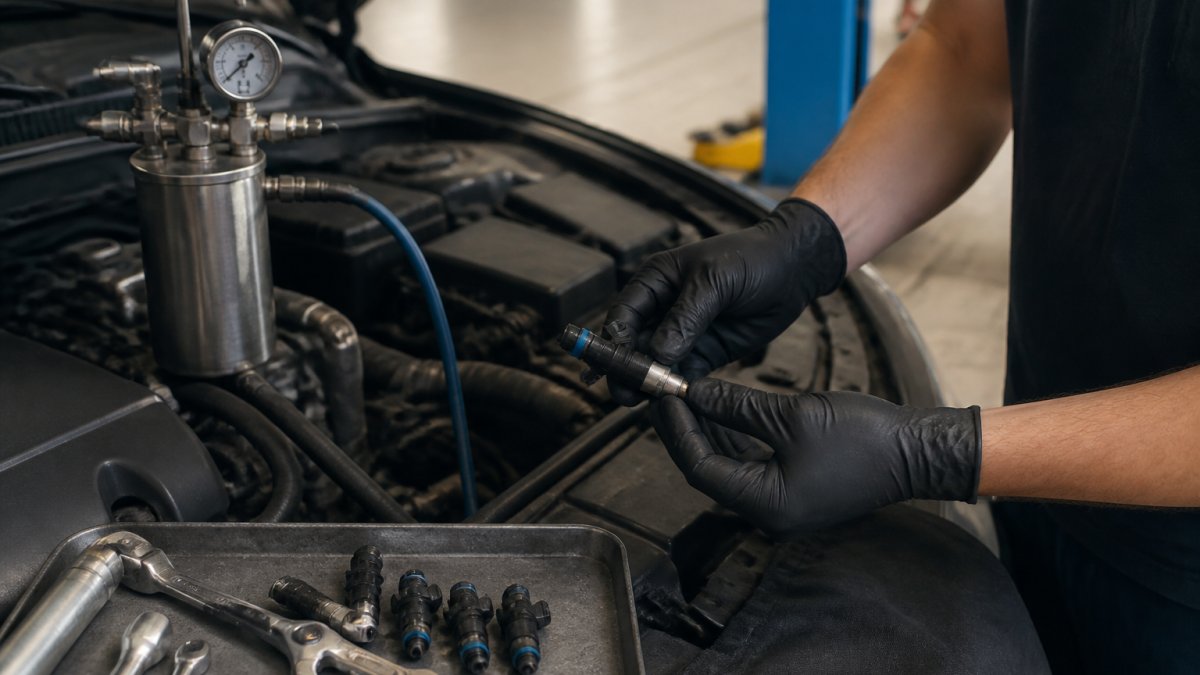
Chemical cleaning, adding a fuel system cleaner to your tank, is the simplest approach. You pour the product into a full fuel tank and drive normally. The cleaner circulates through the fuel system with each fuel cycle, gradually dissolving deposits. This method works best for light-to-moderate deposit accumulation and ongoing maintenance. Most performance vehicles benefit from chemical cleaning every 10,000-15,000 miles.
Professional ultrasonic cleaning removes injectors and cleans them in a specialized machine that uses sound waves to dislodge stubborn deposits. This method is necessary when chemical cleaning alone can't restore proper spray patterns. You'll notice this need if your engine still misfires, hesitates, or shows rough idle after chemical treatment. Ultrasonic cleaning typically costs more but guarantees complete deposit removal.
Decide between the two based on your symptoms. If your engine runs rough, hesitates under acceleration, or shows reduced throttle response, start with chemical fuel system cleaner. If those symptoms persist after one or two treatments, professional ultrasonic cleaning is your next step.
Fuel Injector Cleaner for Direct Injection Engines: Special Considerations
Direct injection engines require different cleaning strategies than traditional port injection engines. In direct injection systems, fuel sprays directly into the combustion chamber at high pressure, which means injector deposits have a more pronounced effect on performance and emissions.
Port injection engines spray fuel into the intake port, where it mixes with incoming air before reaching the combustion chamber. This design offers some natural cleaning because the air stream helps carry away light deposits. Direct injection bypasses this advantage, deposits form directly in the combustion chamber and on intake valves with less opportunity for natural cleaning.
This difference means direct injection engines accumulate carbon deposits faster and show performance loss more visibly. A small deposit in a port injector might go unnoticed. The same deposit in a direct injector can cause visible hesitation or misfire because fuel spray patterns are more critical.
When selecting a fuel system cleaner for direct injection, prioritize products specifically formulated for direct injection compatibility. These cleaners contain detergent packages designed for the higher pressures and tighter tolerances of direct injection systems.
Performance gains from cleaning direct injection engines are often more dramatic than port injection cleaning because the baseline condition is usually worse. Many direct injection owners report noticeable throttle response improvement and smoother idle after treatment.
How Often to Use Fuel System Cleaner: Maintenance Intervals That Matter
The right maintenance interval depends on your driving style, fuel quality, and engine modifications. A stock engine with highway miles and premium fuel needs less frequent cleaning than a heavily modified track engine running on pump gas.
For most performance-focused drivers, a fuel system cleaner treatment every 10,000-15,000 miles is appropriate. This interval prevents significant deposit accumulation while avoiding over-cleaning. If you drive aggressively, run lower-octane fuel, or have a heavily modified engine, shorten that to 8,000-10,000 miles.
Track-focused builds warrant more frequent attention. A race engine that sees weekly track days should receive fuel system cleaner every 5,000-8,000 miles because the sustained high RPM operation accelerates deposit formation. The combustion temperatures and fuel mixture changes at the track create conditions that deposit carbon faster than street driving.
Monitor your engine's response as the primary indicator. If you notice hesitation developing mid-season or throttle response degrading over 5,000 miles, move to the shorter interval. If your engine stays responsive and smooth across your typical maintenance schedule, stick with the longer interval.
Selecting a Fuel System Cleaner: Key Criteria and Common Mistakes
Three criteria separate effective fuel system cleaners from products that underdeliver: detergent concentration, fuel type compatibility, and system-wide coverage.
Detergent concentration determines cleaning power. Higher concentrations dissolve deposits faster but require proper dosing, too much can affect fuel stability. Look for products that specify their detergent content or active ingredient percentage. Vague claims about "powerful cleaning" without concrete specifications usually indicate lower concentration.
Fuel type compatibility matters more than most buyers realize. A fuel system cleaner formulated for gasoline may not work effectively in ethanol blends or race fuel. If you run E85 or race fuel regularly, verify that your cleaner is compatible before purchasing. Incompatible products can separate or precipitate in your fuel tank, creating new problems.
System-wide coverage means the cleaner addresses injectors, fuel rails, fuel lines, and intake valves. Some products focus narrowly on injectors and miss the broader fuel system. For performance applications, broader coverage delivers better results because carbon deposits form throughout the fuel pathway.
Common mistakes include buying based on brand recognition alone, using incompatible cleaners for your fuel type, and over-treating. A well-known brand isn't necessarily formulated for your specific engine configuration or fuel. Incompatible cleaners can cause phase separation or gum formation. Over-treatment stresses fuel system components and wastes money.
The Boost Pros offers expert-vetted solutions for fuel optimization. This helps prevent the guesswork that leads to wasted treatments or incompatible products.
Realistic Expectations: What Fuel System Cleaners Can and Cannot Do
Understanding what fuel system cleaners actually accomplish prevents disappointment and unrealistic expectations. A fuel system cleaner improves performance by restoring fuel delivery to its designed state, it doesn't exceed that baseline.
Fuel system cleaners can restore lost throttle response, smooth out rough idle, and eliminate minor hesitation caused by deposit accumulation. They improve fuel economy when deposits have been restricting fuel flow. They reduce emissions by allowing more complete combustion.
What fuel system cleaners cannot do is add horsepower beyond your engine's design. If your engine is rated for 350 horsepower, cleaning the fuel system won't push it to 380.
Fuel system cleaners also cannot fix mechanical problems. If your engine knocks due to low octane fuel, a cleaner won't solve that, you need higher-octane fuel or an octane booster. If your ignition timing is off, cleaning won't compensate.
The timeline for results varies. Chemical fuel system cleaners work gradually over multiple fuel cycles. You might notice improvement within one tank of fuel, but full cleaning typically takes 2-3 tanks.
For track-focused builds, fuel system cleaner is preventive maintenance that keeps your engine performing at its peak. For street performance, it's a cost-effective way to restore throttle response and smooth operation.
Selecting the right fuel system cleaner starts with understanding your engine's needs and your fuel quality. Explore our fuel system maintenance products and get the guidance you need to keep your engine responsive and reliable. EPA guidance on fuel system maintenance and industry standards support regular fuel system cleaning as part of engine longevity strategy.
| Cleaning Method | Best For | Frequency | Results Timeline |
|---|---|---|---|
| Chemical fuel system cleaner | Maintenance and light deposits | Every 10,000-15,000 miles | 2-3 fuel cycles |
| Professional ultrasonic cleaning | Heavy deposits and performance loss | As needed | Immediate |
| Fuel injector-specific cleaner | Routine maintenance between deep cleanings | Every 5,000 miles | 1-2 fuel cycles |
| Fuel system cleaner for direct injection | Direct injection engines | Every 8,000-12,000 miles | 2-3 fuel cycles |
A clean fuel system is the foundation of consistent performance. According to industry standards for fuel system maintenance, regular fuel system cleaning extends engine life and maintains optimal combustion efficiency.
Frequently Asked Questions
Will fuel injector cleaner actually improve engine performance?
Fuel injector cleaner can restore performance when deposits have reduced throttle response, caused hesitation, or created rough idle. However, gains depend on how much buildup exists. A well-maintained engine with minimal deposits may see no noticeable change. Direct injection engines accumulate deposits faster on intake valves, so cleaners designed for DI systems tend to show clearer results than those for port-injection engines. Realistic expectations: smoother combustion and sharper response, not dramatic horsepower gains.
What's the difference between fuel injector cleaner and a complete fuel system cleaner?
Fuel injector cleaner targets deposits at the injector nozzle and combustion chamber. A complete fuel system cleaner treats the entire fuel system including the tank, fuel rail, fuel lines, and intake valves. For performance-focused vehicles, a complete fuel system cleaner is often more effective because it removes carbon deposits throughout the combustion chamber and intake valves, not just at the injector tip. Choose based on your specific problem: rough idle or hesitation usually points to injector deposits, while overall power loss suggests broader system buildup.
How often should you use a fuel system cleaner for a performance vehicle?
Most manufacturers recommend using fuel system cleaner every 3,000 to 5,000 miles for vehicles in heavy-duty use or those showing signs of deposit buildup. For performance-focused drivers doing frequent track days, quarterly treatments during racing season can help maintain clean fuel delivery and consistent combustion. However, modern detergent gasoline already contains some cleaning agents, so over-treating can be wasteful. Monitor your engine's throttle response and fuel economy; if both remain sharp, you may need cleaning less often than manufacturers suggest.
Can fuel system cleaner fix engine knock or misfire in a modified engine?
Fuel system cleaner can help if knock or misfire stems from carbon deposits blocking fuel spray patterns or reducing combustion efficiency. However, knock in a heavily modified engine often indicates insufficient octane rating, improper ignition timing, or engine damage, problems a cleaner cannot solve. Before using a fuel system cleaner to address knock, verify your fuel octane meets your engine's requirements and check ignition timing with a professional. Cleaners work best as preventive maintenance, not as a fix for underlying tuning or fuel quality issues.