

Race Fuel vs Octane Booster: Which Wins for Racing
Table of Contents
- Race Fuel vs Octane Booster: Core Differences
- Race Fuel vs Pump Gas: Why Dedicated Race Fuel Matters
- Best Octane Booster for Racing: When Additives Make Sense
- How Much Octane Booster to Use: Mixing Ratios and Calculations
- Race Fuel vs E85: Oxygenated Performance and Cooling Benefits
- Performance Gains, Power Output, and Real-World Testing
- Cost Comparison and Storage Considerations
- Which Option Wins: Decision Framework by Engine Setup
- Frequently Asked Questions
Last Updated: October 12, 2026
Race Fuel vs Octane Booster: Core Differences
On the track, your fuel choice is the difference between a smooth run and catastrophic detonation. The answer isn't simply "pick the higher octane number."
Race fuel and octane booster are fundamentally different products. Race fuel is a complete fuel formulation engineered from the ground up for extreme performance.

What Makes Them Different
Race fuel arrives as a finished product with its octane rating, composition, and additive package already balanced, you pour it straight in.
Race fuel offers consistency: every gallon has the same formulation, combustion characteristics, and knock resistance.
Octane booster trades consistency for flexibility and cost.
Octane Rating, RON, and MON: Understanding the Numbers
A fuel rated 109 octane might have a RON of 114 and a MON of 100: under light acceleration it behaves like 114-octane, under hard boost like 100-octane.
Race fuel specifications often list both RON and MON separately. SAE fuel standards for race applications define these measurements precisely so you can compare fuels across brands.
Race Fuel vs Pump Gas: Why Dedicated Race Fuel Matters
Pump gasoline is formulated for everyday driving: cold starts, idling, moderate acceleration, fuel economy. It contains detergents, corrosion inhibitors, and volatility characteristics suited to normal temperatures, good things for your daily commute.
They're terrible for racing.
Fuel Composition and Additives
Race fuel strips away street-driving additives and volatility specs, replacing them with compounds optimized for extreme combustion.

Pump gasoline also contains ethanol (typically 10% in the US, varying by region and season).
Additive packages differ too. Pump fuel additives fight carbon deposits on intake valves, irrelevant for race engines running fresh fuel per event.
Knock Resistance and Engine Protection
Detonation (engine knock) occurs when fuel ignites before the spark plug fires, creating a pressure wave that collides with the normal flame front.
Octane rating measures resistance to detonation under test conditions. Higher octane means the fuel resists ignition longer, giving the spark plug time to ignite the charge at the right moment.
But octane is only part of it.
Best Octane Booster for Racing: When Additives Make Sense
Octane booster makes sense in specific scenarios: you're running moderate boost pressure (under 12 psi), your engine tune is conservative, and you need a quick octane bump without buying dedicated race fuel. BOOSTane Professional, for example, increases octane levels up to 116 in a 32 fl oz can designed for convenient dosing.

Additive Chemistry and Performance Limits
Octane booster works via chemicals that resist detonation, most commonly methylcyclopentadienyl manganese tricarbonyl (MMT) or other organometallic compounds. They genuinely raise octane, but they have limits.
The first limit is concentration. A typical booster adds 5-10 points depending on blend ratio and base octane: 87-octane pump gas at maximum concentration might reach 97-98.
The second limit is fuel system compatibility.
Cost Efficiency and Practical Application
Cost-per-octane-point is where octane booster shines for casual racers. A 32 fl oz can of BOOSTane Professional costs around $29.99 and boosts a 15-gallon tank by roughly 5-7 octane points depending on starting octane, about $2 per gallon treated, far cheaper than dedicated race fuel.
But the math changes for serious racing. If you need 110+ octane consistently, you're blending so much booster that cost efficiency collapses, you're better off buying race fuel outright.
How Much Octane Booster to Use: Mixing Ratios and Calculations
Getting the blend ratio right is critical. Too little booster and you don't reach your target octane. Too much and you're wasting money while potentially introducing deposit or fouling issues.
Calculating Octane Blend Levels
The calculation is simple algebra.
Here's the formula: (Target Octane - Starting Octane) ÷ Octane Boost Provided = Fraction of Booster Needed
For a 15-gallon tank, that's 15 × 0.09 = 1.35 gallons of booster.
This assumes linear blending, which is approximately correct at small concentrations but less accurate at high ones.
Fuel Compatibility and Ethanol Considerations
Most octane boosters work fine with ethanol-blended pump fuel (E10), but some react poorly with higher concentrations. Before blending with E15 or E85, check compatibility, some formulations separate or precipitate in high-ethanol blends, defeating the purpose.
This is where race fuel has a clear advantage. BOOSTane E85 Race Fuel is formulated specifically for ethanol blends, with chemistry balanced around 85% ethanol content, you're not mixing incompatible products, you're using fuel engineered for that concentration.
For standard E10 pump gas, compatibility is rarely an issue.
Race Fuel vs E85: Oxygenated Performance and Cooling Benefits
E85 (85% ethanol, 15% gasoline) occupies a unique space in racing fuel. It's not quite a traditional race fuel, but it's not pump gas either. For forced induction engines, E85 offers cooling benefits that standard race fuel can't match.
Oxygen Content and Combustion Efficiency
Ethanol contains roughly 35% oxygen by weight versus gasoline's zero.
The stoichiometric ratio (ideal air-to-fuel for complete combustion) also differs: gasoline burns best near 14.7:1, ethanol near 9:1.
BOOSTane E85 Race Fuel and the DEMON 170 BLEND are formulated to use this oxygen content.
E85 Chemical Intercooling for Boosted Engines
Here's where E85 becomes genuinely special: latent heat of evaporation.
BOOSTane 109 OCTANE Race Fuel →
This "chemical intercooling" is why E85 racers run higher boost and more aggressive timing than equivalent gasoline builds.
The tradeoff: E85 requires a fuel system designed for it.
SAE technical bulletin on ethanol fuel properties documents these characteristics in detail.
Performance Gains, Power Output, and Real-World Testing
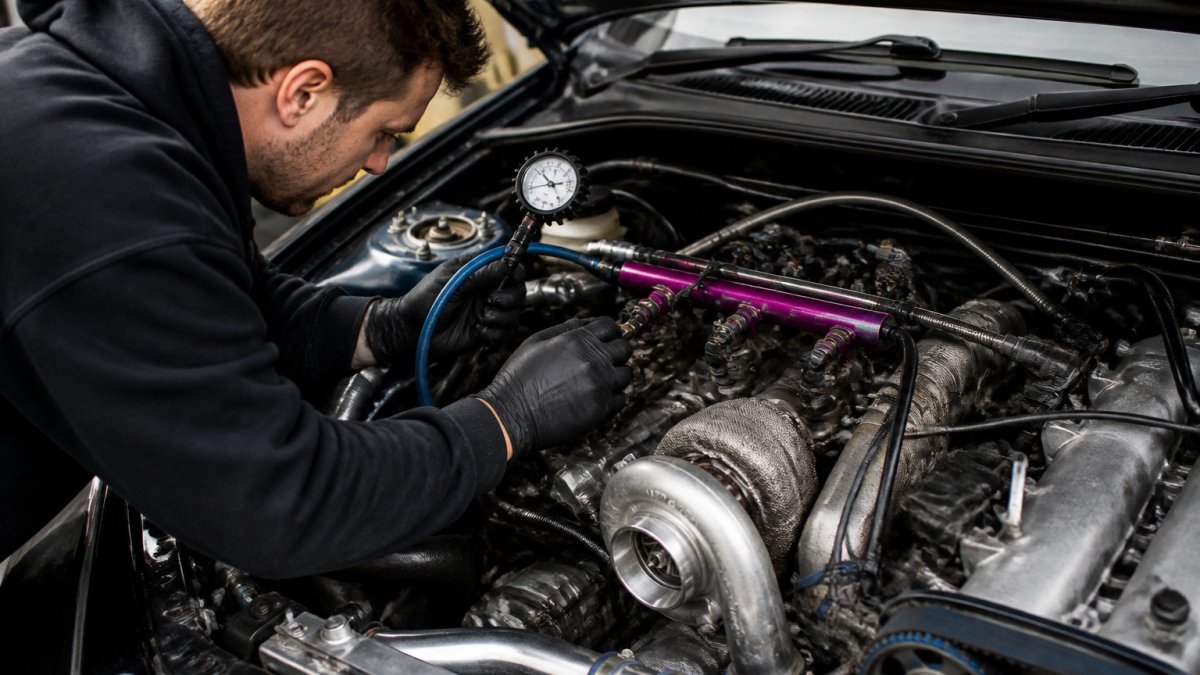
The question every racer asks: how much power do you actually gain? The answer depends entirely on your current setup and what's limiting your engine.
Ignition Timing, Boost Pressure, and Engine Tuning
Your tune determines whether switching fuels yields 5 horsepower or 50. The tune is the software (or mechanical settings) controlling ignition timing, injection duration, and boost pressure.
The critical insight most racers miss: fuel and tune are inseparable. A fuel change only unlocks power if your engine is currently knock-limited, that is, detonation is preventing you from advancing timing or running more boost.
Detonation Prevention and Compression Ratio Limits
Every engine has a compression ratio, cylinder volume at bottom dead center versus top dead center.
Here fuel choice becomes non-negotiable. No tune makes a high-compression engine safe on low-octane fuel, it will detonate and risk catastrophic failure.
BOOSTane 116 Race Fuel, at 120 RON and 114 MON, is engineered for extreme compression and boost, rated up to 16:1 at 9,500 RPM with nitrous.
Cost Comparison and Storage Considerations
The financial decision between race fuel and octane booster isn't just about per-gallon price, it's about total cost of ownership, storage logistics, and how often you race.
Price Per Gallon and Blending Economics
BOOSTane Professional costs $29.99 for 32 fl oz (0.25 gallons), roughly $120 per gallon of booster.
BOOSTane 109 Race Fuel costs $124 per gallon. A 15-gallon tank costs $1,860.
The real comparison is tanks per event.
For a casual racer doing 4 events a year, octane booster is clearly cheaper.
Fuel System Compatibility and Handling Safety
Race fuel needs proper storage: it's volatile and degrades in sunlight, high heat, or rusting steel containers.
Octane booster is less storage-sensitive but still prefers cool, dark conditions.
Fuel system compatibility is more nuanced.
Octane booster generally suits any pump-gas-compatible fuel system, but some formulations cause injector deposit buildup at very high concentrations.
EPA regulations on racing fuel additives and street legality provide guidance on which additives are allowed in street vehicles versus racing-only applications.
Which Option Wins: Decision Framework by Engine Setup
The choice between race fuel and octane booster depends on three factors: your engine's compression ratio, your current boost pressure, and how often you race.
| Engine Type | Recommended Fuel | Reasoning | Best Product |
|---|---|---|---|
| Naturally aspirated, stock compression | Octane booster | Low detonation risk, marginal gains | BOOSTane Professional |
| Naturally aspirated, high compression (12:1+) | Race fuel | Detonation prevention essential | BOOSTane 109 |
| Forced induction, mild boost (under 10 psi) | Octane booster | Moderate detonation risk, cost-effective | BOOSTane Professional |
| Forced induction, high boost (10-15 psi) | Race fuel | Detonation risk significant, consistency critical | BOOSTane 109 or 116 |
| Extreme compression or nitrous (16:1+) | Race fuel | Detonation risk extreme, highest octane required | BOOSTane 116 |
| E85-compatible engine, high boost | E85 race fuel | Chemical intercooling advantage | BOOSTane E85 or DEMON 170 |
Light Track Days and Weekend Warriors
For occasional track days in a street car or lightly modified vehicle, octane booster is the practical choice.
The advantage is flexibility: adjust your blend ratio to your tune, the weather, and how hard you're pushing, without committing to full tanks of race fuel for an easy weekend.
The limitation: you'll hit a ceiling around 100-105 octane at reasonable concentrations.
Forced Induction and High-Performance Builds
Add a turbocharger or supercharger and the equation shifts.
For forced induction, race fuel is safer and often more economical.
At extreme boost (18+ psi) or with high-compression pistons, choose BOOSTane 116 Race Fuel (117 R+M/2 octane). Its higher octane and leaded formulation add knock resistance for competition racing where engine protection is paramount.
Off-Highway and Competition Racing
Competition racing, drag, road, or off-highway, requires race fuel.
For off-highway racing (Baja, rock crawling, UTV), BOOSTane 109 Race Fuel is designed specifically for these applications, with an oxygenated formulation.
If you're competing, use race fuel, the marginal cost difference versus engine failure risk is trivial.
The race fuel versus octane booster decision comes down to one question: what's your engine's actual limit? At The Boost Pros, we deliver proven, engineering-backed products supported by enthusiast-level expertise. SHOP ALL PERFORMANCE and find the fuel that unlocks your engine's true potential.
Frequently Asked Questions
What is the difference between race fuel and an octane booster?
Race fuel is a complete, purpose-built fuel formulation with high octane ratings, specialized additives, and controlled composition optimized for extreme performance. Octane boosters are liquid additives mixed into pump gasoline to raise its octane level. Race fuel provides consistent performance across the entire combustion cycle, while octane boosters work within the limits of the base fuel's chemistry. For serious racing, dedicated race fuel offers superior knock resistance and protection, especially at high compression and boost pressures.
Can an octane booster replace race fuel?
Octane boosters can increase octane levels, but they cannot fully replace race fuel for high-performance applications. A booster like BOOSTane Professional can increase octane up to 116, making it suitable for weekend track days and light modifications. However, race fuel offers additional benefits: controlled fuel composition, superior additive packages, oxygenated or non-oxygenated options for specific tuning needs, and proven reliability under extreme conditions. For heavily modified engines, forced induction, or competitive racing, dedicated race fuel is the more reliable choice.
How much octane booster should I add to my fuel tank?
Mixing ratios depend on your target octane and base fuel octane. Most octane boosters, including BOOSTane Professional, are designed to treat a full tank. A 32 fl oz can typically treats a standard fuel tank to boost octane by several points. To calculate your exact blend, subtract your base fuel octane from your target octane, then determine the booster concentration needed. For example, if your pump gas is 91 octane and you want 98 octane, you need enough booster to close that 7-point gap. Always follow the product's dosage instructions to avoid over-treating, which wastes product and provides no additional benefit.
Is race fuel better than E85 for racing?
Both have distinct advantages depending on your engine and setup. Traditional race fuels like BOOSTane 109 or 116 provide high octane, excellent knock resistance, and stable performance across a wide temperature range. E85 race fuel offers chemical intercooling through its high ethanol content, which cools the intake charge and allows more aggressive tuning on forced induction engines. E85 also provides oxygenated combustion, improving power output in some applications. The choice depends on your engine's fuel system compatibility, tuning strategy, and whether you need the cooling benefits of ethanol or the consistency of traditional race fuel.
How much does race fuel cost compared with an octane booster?
BOOSTane octane booster costs $29.99 per 32 fl oz can and treats a full tank, making it the most economical option for occasional use. Race fuels range from $69 per gallon for BOOSTane E85 to $124 per gallon for BOOSTane 109 unleaded race fuel. For weekend track days using an octane booster on pump gas, your per-use cost is minimal. For serious racing requiring full-tank race fuel, costs are significantly higher but deliver superior performance, protection, and reliability. Calculate your total season cost based on fuel consumption and how often you race to determine the best value for your specific use.