

Lucas Oil vs STP: Choosing the Right Oil Additive
Table of Contents
- Lucas Oil Stabilizer vs STP Oil Treatment: Core Differences
- Do Oil Additives Actually Work? What the Evidence Shows
- Lucas Oil Stabilizer Alternatives Worth Considering
- STP Oil Treatment Alternatives and How They Compare
- Oil Additive Compatibility with Synthetic Oil: What You Need to Know
- Manufacturer Recommendations for Engine Oil Additives
- When Not to Use an Oil Additive: Red Flags and Safe Practices
- Frequently Asked Questions
Last Updated: October 18, 2026
Lucas Oil Stabilizer vs STP Oil Treatment: Core Differences
Oil additives come in two main categories: Lucas-style stabilizers and STP-style treatments, though oil additive alternatives exist across both types. They work through fundamentally different mechanisms, and choosing the wrong one can waste money or cause problems down the line.
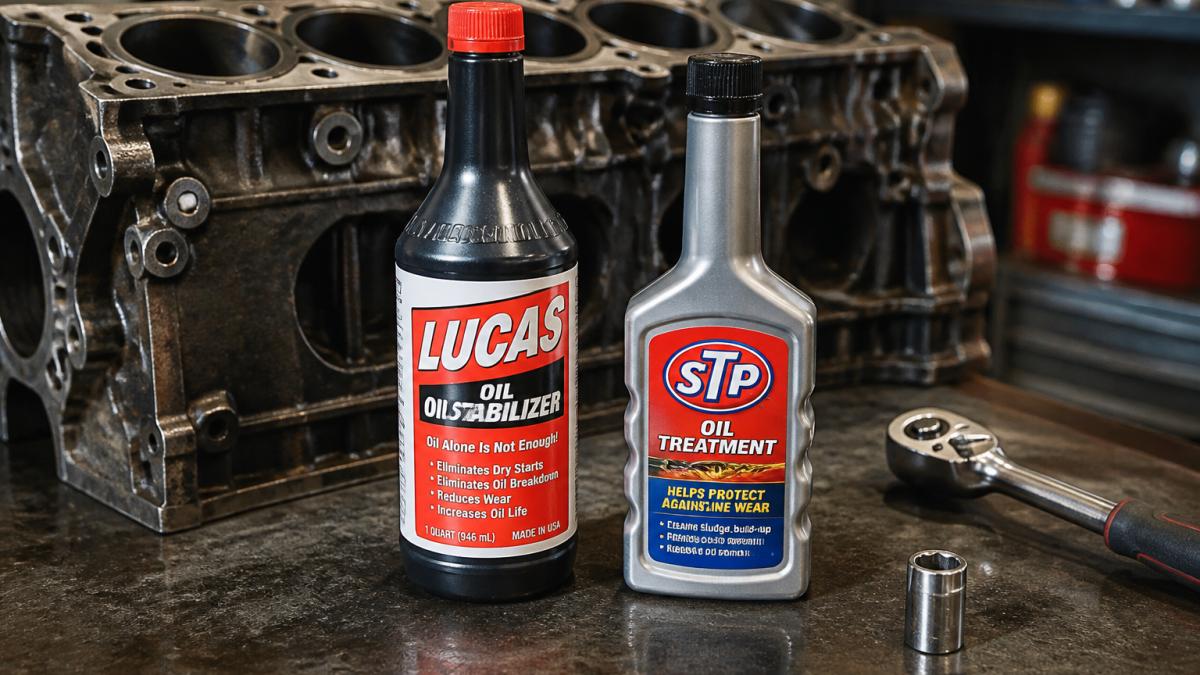
How Lucas-style oil stabilizers work
Lucas Oil Stabilizer is a viscosity improver.
The theory: thicker oil creates a stronger barrier against metal-to-metal contact. This appeals to owners of worn engines where increased bearing and journal clearances let more oil escape, a thicker film compensates for those gaps.
A Lucas-style stabilizer doesn't replace your oil, it modifies its properties. Most users report it blends cleanly into conventional or synthetic oil without separation or settling.
How STP-style oil treatments work
STP Oil Treatment takes a different approach: rather than thickening oil, it focuses on conditioning and cleaning, with detergents and anti-wear compounds that reduce friction and clean engine deposits.
STP-style products work alongside your existing oil, circulating through the oil system to coat surfaces and reduce wear. Many users apply STP preventively or when they suspect carbon buildup is affecting performance.
The key difference: Lucas thickens; STP conditions. One increases viscosity; the other targets friction and cleanliness. Both claim to extend engine life, but through different mechanisms.
Do Oil Additives Actually Work? What the Evidence Shows
Lubrication science confirms that proper oil viscosity and film strength matter for engine protection (Using multiple linear regression to predict engine oil life).
Many mechanics report positive experiences with both products, particularly in older or higher-mileage engines. But smoother idle or reduced knock is subjective and hard to isolate from other variables.
The risk is paying for minimal benefit, or causing unintended consequences like increased oil pressure, thicker sludge, or compatibility issues with your lubrication system.
Lucas Oil Stabilizer Alternatives Worth Considering
If you're looking for oil additive alternatives to Lucas, several options target similar goals through comparable mechanisms.
Redline Oil treatments work like Lucas, increasing viscosity and adding conditioning agents.
Royal Purple Max-Tane is another viscosity-focused product for worn engines, compatible with conventional and synthetic oils.
Mobil 1 Advanced Fuel Economy (an oil with enhanced additives rather than a separate product) offers built-in viscosity improvement, factory-blended and tested together.
The common thread: all aim to protect worn engines or improve lubrication through viscosity enhancement or friction reduction.
STP Oil Treatment Alternatives and How They Compare
STP Oil Treatment is a crankcase conditioner: detergents, dispersants, anti-wear compounds (historically ZDDP), and friction modifiers in a carrier oil. Alternatives fall into three buckets, and confusing them is the most common buyer mistake.
Bucket 1: Crankcase oil treatments (direct STP substitutes)
These go into the engine oil fill, not the fuel tank, and are the true STP alternatives.
- Liqui Moly MoS2 Anti-Friction Engine Treatment, uses molybdenum disulfide (MoS2) as a solid-film friction modifier. MoS2 plates onto metal surfaces and can reduce friction under boundary lubrication conditions where the oil film breaks down. It is not a thickener in the Lucas sense; viscosity change is modest. Dosage is typically one 300 ml can per 3-5 liters of oil, per the label.
- Wynn's Engine Oil Treatment, positions itself around friction reduction and seal conditioning. Contains anti-wear chemistry and is marketed for higher-mileage engines. Follow the label ratio; over-dosing is a common error.
- Amsoil Engine Flush and Amsoil Upper Cylinder Lubricant, note these are different products for different jobs. The flush is a pre-oil-change cleaner; the upper cylinder lubricant is a fuel additive. Neither is a drop-in STP substitute, despite the brand association.
- Ceratec (Liqui Moly), ceramic (hexagonal boron nitride and similar) particle-based friction modifier. It is often grouped with STP-style conditioners because it targets friction rather than viscosity, but the mechanism (surface film) differs from detergent-based conditioning.
Bucket 2: Fuel-system cleaners (often mistaken for oil treatments)
Chevron Techron Concentrate Plus and Gumout High Mileage Fuel System Cleaner are fuel additives, not crankcase treatments. They clean injectors, intake valves (on port-injection engines), and combustion chamber deposits via PEA chemistry, appropriate for deposit cleaning, not oil conditioning.
Bucket 3: Oil-with-built-in-additives (the no-additive route)
Instead of layering a treatment onto oil, choose an oil whose additive package is engineered and tested as a whole. High-mileage oils (Mobil 1 High Mileage, Valvoline High Mileage with MaxLife, Pennzoil Platinum High Mileage) include seal conditioners, detergents, and anti-wear chemistry at validated treat rates, the lowest-risk route, since the formulator balanced the chemistry against the base oil and specifications (API SP, ILSAC GF-6A/GF-6B, ACEA).
How to actually compare them
| Criterion | What to check |
|---|---|
| Where it goes | Oil fill vs. fuel tank, never mix these up |
| Mechanism | Detergent/dispersant, anti-wear (ZDDP or ashless), friction modifier (MoS2, ceramic), or thickener |
| Viscosity impact | Does the label state a viscosity change, or only friction/detergent claims? |
| Specification compatibility | Does it claim API SP / ILSAC GF-6 compatibility, or is it silent? |
| Dosage | Label ratio per liter/quart of oil, more is not better |
| Warranty posture | Does your OEM manual prohibit oil additives? |
The distinction matters because STP-style products are conditioners first, thickeners second. If your goal is cleaning deposits or reducing friction rather than compensating for worn clearances, the crankcase treatments above deserve consideration, but read the label's specification claims before you buy, and treat fuel-system cleaners as a separate purchase for a separate problem.
Oil Additive Compatibility with Synthetic Oil: What You Need to Know
The real question is why synthetic oils are less forgiving of aftermarket additives, and what signals tell you whether a product is safe to add.
Why synthetic base oils change the compatibility equation
A finished motor oil is a balanced system: base oil, viscosity modifier, detergent, dispersant, anti-wear, friction modifier, antioxidant, pour-point depressant, and antifoam, each at a treat rate chosen to meet a specification such as API SP, ILSAC GF-6A/GF-6B, ACEA A3/B4 or C3, or OEM approvals like dexos1 Gen 3 or VW 504 00/507 00.
Synthetic base stocks (Group IV PAO and Group V esters) have different solvency and seal-swell behavior than conventional Group II/III oils. Adding a third-party package can:
- Unbalance the detergent/dispersant ratio, causing deposits to drop out rather than stay suspended.
- Overdose anti-wear chemistry, which is not automatically better, excess ZDDP can increase phosphorus volatility and, in some formulations, accelerate deposit formation.
- Change seal swell, leading to leaks in engines whose seals were tuned to the OEM oil's swell characteristics.
- Shear or thicken unpredictably when a viscosity modifier from the additive interacts with the oil's own viscosity modifier.
The specification test (use this before buying)
A product that is genuinely engineered for modern oils will state which specifications it is compatible with. Look for explicit claims such as:
- "Compatible with API SP / ILSAC GF-6"
- "Suitable for use with dexos1 Gen 3"
- "Does not affect ACEA C3 / mid-SAPS compliance"
If the label only says "safe for all oils" or is silent on specifications, treat that as a warning sign. Legitimate formulators know that OEM approvals are the currency of compatibility and will name them.
What the OEMs actually say
Most modern owner's manuals include language along the lines of "do not use oil additives" or "use only oil meeting the specified specification." This is not marketing, it reflects that the engine's durability testing, emissions compliance (catalytic converter and GPF/DPF compatibility), and fuel-economy certification were all done on the specified oil. Adding an unapproved treatment can:
- Increase phosphorus or sulfur beyond what the emissions system was validated for (relevant to catalytic converters and gasoline particulate filters).
- Change viscosity outside the range the variable valve timing (VVT) and hydraulic lash adjusters were calibrated for.
- Affect turbocharger bearing oil flow and coking behavior.
Practical compatibility matrix
| Oil type | Additive risk level | Why |
|---|---|---|
| Conventional / high-mileage | Lower | Looser formulation tolerances; seal conditioners already present |
| Synthetic blend | Moderate | Mixed base stocks; check specification claims |
| Full synthetic (API SP / GF-6) | Higher | Tightly balanced package; OEM approvals matter |
| Full synthetic with OEM approval (dexos, VW 504 00, MB 229.51) | Highest | Any deviation can void the approval basis |
The safest path
If you run full synthetic and want added protection, the lowest-risk option is to choose an oil that already includes the chemistry you want, high-mileage synthetics with seal conditioners, or oils carrying the OEM approval your engine requires, rather than layering a separate treatment on top. If you still want to add a product, verify three things first: the label names your oil's specification, the dosage is stated per liter/quart, and your owner's manual does not prohibit additives. If any of those three is missing, skip the additive.
Manufacturer Recommendations for Engine Oil Additives
Your vehicle's manufacturer has specific guidance on this, and most of it points away from aftermarket additives.
Modern engines are designed for oil meeting specific standards (ILSAC GF-6, ACEA).
Adding an unapproved additive can violate your warranty.
Some pre-2000s engines were built with looser tolerances and benefit from thicker oil or extra conditioning, and guidance for them is often more permissive.
Check your owner's manual for explicit guidance. If it doesn't mention aftermarket additives, assume they're not approved.
When Not to Use an Oil Additive: Red Flags and Safe Practices
Certain situations demand caution or warrant avoiding oil additives altogether.
Don't use additives if your engine is under warranty. The risk of warranty denial outweighs any potential benefit.
Avoid thickening additives on modern engines. Current engine designs rely on precise oil viscosity for fuel economy and emission control.
Don't mix multiple additives. Using Lucas and STP together, or combining either with other treatments, multiplies the risk of chemical incompatibility.
Safe practice: follow dosage instructions exactly, more is not better.
The bottom line: Lucas Oil and STP represent two different philosophies, thickening versus conditioning.
For performance-focused builds where engine protection is critical, explore The Boost Pros's VPO Liquid Boost oil vitalizers, which are engineered specifically for high-performance applications and tested for compatibility with modern engine specifications.
Frequently Asked Questions
Do oil additives actually improve engine protection and reduce wear?
Oil additives can provide measurable benefits under specific conditions, particularly in older or worn engines where metal-to-metal contact increases. Modern synthetic oils already contain factory additives optimized for current engine designs, so additional treatment may offer minimal gain in newer vehicles. The key variable is oil film thickness and circulation, additives work by improving viscosity and lubrication, but they cannot compensate for worn engine clearances or low oil pressure. Results depend on engine condition, driving patterns, and whether the additive is compatible with your existing motor oil grade.
Is Lucas Oil Stabilizer better than STP Oil Treatment, or are they essentially the same?
Both products increase oil viscosity and thickness, but they differ in formulation approach. Lucas-style stabilizers typically use a heavier base oil to boost viscosity, while STP-style treatments often rely on polymeric additives. For worn engines with loose clearances, the extra thickness may reduce oil consumption and noise. However, neither is universally superior, effectiveness depends on your specific engine condition, oil type, and whether manufacturer specifications permit thicker oil. Neither can fix underlying mechanical wear.
Can I use oil additives in synthetic oil, or will they interfere with the synthetic formulation?
Synthetic oils already contain robust additive packages designed by the manufacturer to work as a complete system. Adding aftermarket additives risks destabilizing that balance, potentially reducing film strength or causing sludge buildup. Before mixing any oil treatment with synthetic oil, check both the synthetic oil's technical data sheet and the additive's compatibility statement. Some synthetic blends tolerate additives better than full synthetics. When in doubt, contact the oil manufacturer, they can advise whether an additive will compromise warranty or performance.
What do vehicle manufacturers say about using aftermarket oil additives?
Most vehicle manufacturers specify an oil grade and viscosity in your owner's manual and recommend against adding aftermarket treatments unless the engine is experiencing a specific problem (such as oil leakage or consumption). Using an additive that changes oil viscosity beyond the manufacturer's specification can void warranty coverage and may cause oil pressure issues or engine damage. Always consult your owner's manual or contact the manufacturer before using any oil additive. For high-mileage or heavily modified engines, professional oil analysis can reveal whether an additive is actually needed.