

Engine Protection for Track Days: The Ultimate Guide
Table of Contents
- Why Track Days Stress Your Engine (and How to Protect It)
- Your Track Day Car Preparation Checklist
- Best Engine Oil for Track Days: Viscosity, Temperature, and Additives
- Track Day Engine Overheating Prevention
- On-Track Driving Habits That Reduce Engine Stress
- Engine Maintenance After a Track Day
- Frequently Asked Questions
Last Updated: October 21, 2026
Why Track Days Stress Your Engine (and How to Protect It)
Engine protection for track days means preparing, monitoring, and maintaining your engine so it survives sustained high-RPM, high-heat driving without accelerated wear.
Most guides treat track preparation as a safety inspection. It isn't. Safety gear keeps you alive; fluid discipline keeps the engine alive.
Three forces do the damage: heat thins the oil and accelerates oxidation, sustained cornering moves oil away from the pickup, and high RPM raises the load on every bearing surface at once.
Your Track Day Car Preparation Checklist
A track day car preparation checklist is a sequenced list of inspections and fluid checks completed in the week before the event, not the morning of. Sequence matters because fluid condition determines what else needs attention.
Pre-Track Vehicle Inspection and Fluid Checks
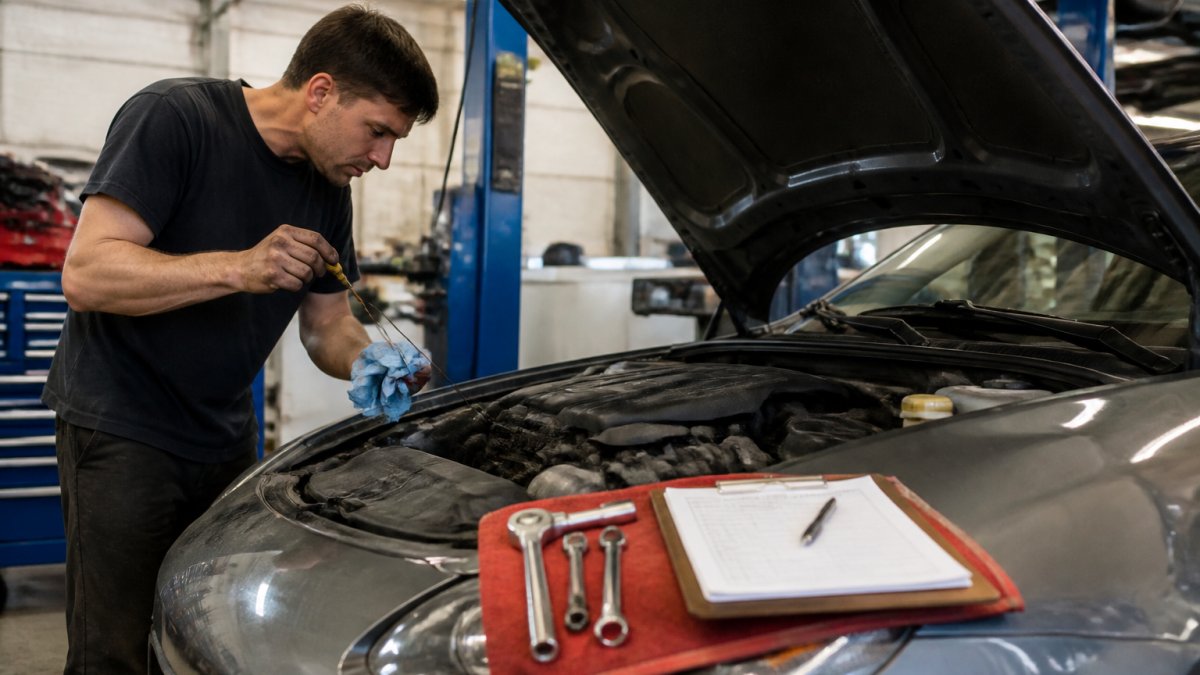
Start under the hood with the engine cold. Check engine oil level on a level surface, and read condition as carefully as quantity.
Work through the fluids in this order:
- Engine oil - level, colour, and smell. Top up or change if in doubt.
- Coolant - level at the cold mark, plus hose and clamp condition.
- Brake fluid - reservoir level and age. Moisture contamination lowers the boiling point.
- Transmission and differential fluid - check intervals against your service history.
- Power steering and washer fluid - quick visual checks.
Then inspect for leaks. A weeping valve cover gasket that drips nothing on the street will spray oil onto a hot manifold under sustained load.
Brakes, Tires, and Safety Equipment
Brake fluid is the item most often skipped and most often responsible for a ruined session. Fresh fluid with a known boiling point removes the guesswork.
Tire pressure and condition decide how much of the engine's output reaches the track. Set pressures cold, note them, and recheck hot after the first session. Inspect sidewalls for cracking and tread for embedded debris.
Safety equipment rounds out the checklist:
- Helmet within date and correct standard for the event
- Harness or seatbelt in good condition, no fraying
- Harness bar or roll protection where the regulations require it
Best Engine Oil for Track Days: Viscosity, Temperature, and Additives
The best engine oil for track days holds its viscosity at sustained high temperature and resists shear under high RPM.
Viscosity choice is a trade-off, not a flex. Going thicker than the factory specification can slow cold flow and reduce oil pressure at startup, where much of the critical engine wear occurs.
This is where an oil vitalizer earns its place. VPO Liquid Boost - STREET Oil Vitalizer from The Boost Pros is a synthetic oil treatment built around a proprietary friction-modifying additive system, formulated to reduce operating temperatures and protect against viscosity breakdown, wear, and thermal or oxidative degradation caused by shear stress.

If your build runs heavier weight oils, VPO Liquid Boost - HOT ROD Oil Vitalizer is formulated for modern and classic engines across diverse operating conditions.
Oil Temperature and Pressure Monitoring
Oil temperature and pressure monitoring means fitting gauges or a data logger so you can see what the oil is doing in real time rather than discovering it after a bearing fails.
Watch both together. Rising temperature with falling pressure at the same RPM is a warning sign, not a data point to log and ignore. A common mistake is fitting a temperature gauge and skipping pressure, the one that catches oil starvation.
Useful reference points, stated as general guidance rather than a spec for your engine:
- Oil temperature - most street oils are comfortable where the manufacturer's gauge sits mid-scale. Sustained track use pushes oil hotter, and oil that stays well above its normal band lap after lap thins out and loses film strength. If temperature keeps climbing session after session, address cooling and oil quality before adding power.
- Oil pressure - pressure should rise with RPM and stay stable at a given RPM and temperature. A reading that sags at high RPM, or drops suddenly in a long corner, points to supply problems rather than a gauge fault.
- Warning signs - a flickering oil pressure light, a gauge that twitches in corners, or a temperature gauge that climbs and does not recover on a cooldown lap are all reasons to back off and investigate rather than push for one more session.
Oil Starvation, Baffled Sumps, and Oil-Control Upgrades
Oil starvation happens when sustained cornering, braking, or acceleration moves oil away from the pickup, so the pump draws air instead of oil. The damage is immediate and cumulative, and it rarely announces itself with a warning light before the bearing is already marked. High-g corners and hard braking are the usual triggers, which is why starvation is a track problem rather than a street one.
Countermeasures, in order of cost and complexity:
VPO Liquid Boost - RACE Oil Vitalizer →
- Keep the oil level at the upper end of the safe range - never below halfway on the dipstick, and check it hot, on level ground, after the engine has settled. This is free and prevents more starvation than any part.
- Fit a baffled sump or improved oil-control kit - a baffled pan traps oil around the pickup under cornering. It is the standard first upgrade for cars that see sustained high-g cornering, addressing the mechanism directly rather than masking it.
- Add an oil catch can where crankcase ventilation pushes oil vapour into the intake. A catch can does not prevent starvation, but it keeps oil vapour out of the intake and helps you see how much blow-by the engine is producing.
A common pattern is to chase power first and oil control last. On a track car, the order is reversed: correct oil level, a baffled sump if the car sees sustained cornering, and monitoring to confirm the fix worked. Bearings do not give a second warning.
Track Day Engine Overheating Prevention
Track day engine overheating prevention comes down to making the cooling system capable of sustained load rather than short bursts. Street driving rarely exposes a marginal radiator; ten laps will. The goal is not just keeping the gauge out of the red, but bringing temperatures down in a controlled way afterward so heat soak does not cook the engine in the paddock.
Cooling-System Preparation and Heat Management
Start with the components that fail silently. A radiator that is marginal on the street is inadequate on track, because sustained load removes the recovery time street driving provides.
Work through the system in this order:
- Radiator core condition - clean the fins of leaves, bugs, and track rubber. A partially blocked core loses capacity exactly when airflow demand is highest. Check the end tanks for seepage at the crimps.
- Hoses and clamps - squeeze every hose when cold. A hose that feels soft or shows bulging at the clamp is a failure waiting for the first heat cycle. Replace rather than re-tighten tired clamps.
- Thermostat and fan - confirm the thermostat opens at its rated temperature and the fan engages. A fan that only runs on the street may not be commanded on at track speeds, so verify the fan circuit works independently of road speed.
- Coolant condition and mix - coolant that has gone acidic or lost its corrosion inhibitors attacks the radiator and water pump from the inside. Replace with the correct mix for your climate; a higher coolant concentration raises the boiling point but reduces heat transfer, so follow the manufacturer's ratio.
- Pressure cap - a tired cap that no longer holds rated pressure lowers the boiling point of the whole system. This is a cheap part that is frequently overlooked.
- Pressure test - pressurize the system cold and look for small leaks that only appear when hot. A pinhole that weeps nothing on the street can spray under sustained load.
Heat management continues on track. Short-shifting out of slow corners reduces time at peak RPM and the heat that comes with it. Using the heater on a hot lap adds a small amount of radiator capacity, a stopgap, not a fix. If the temperature gauge climbs and does not recover on a cool-down stretch, pit rather than push; a warped head or blown head gasket costs far more than a missed session.
The cooldown lap is not optional: it is the cheapest cooling-system upgrade you will ever make. A lap at reduced pace with airflow through the radiator brings temperatures down gradually. Parking a hot car immediately after a session traps heat in the block and under the hood, which is exactly when heat soak does its damage.
On-Track Driving Habits That Reduce Engine Stress
Driving habits decide how much of your preparation pays off. Three matter more than any part you can buy.
- Warm-up properly. Oil temperature lags coolant temperature. Give the engine a full lap at moderate load before chasing revs.
- Use the cooldown lap. A lap at reduced pace with airflow through the radiator brings temperatures down gradually and prevents heat soak in the paddock.
- Respect the redline on downshifts. Mechanical over-rev from a missed downshift causes damage that no additive can prevent.
Smooth inputs help too. Snatching gears and dumping the clutch shock the drivetrain and load the engine unevenly; progressive throttle out of corners is faster and kinder.
Engine Maintenance After a Track Day
Engine maintenance after a track day starts with a post-session inspection while the car is still hot, then a fluid service once it has cooled.
After the final session, check oil level and look for fresh leaks around the valve cover and sump.
Shorten your service intervals compared with the street schedule. To match the right vitalizer to your engine type, shop the full performance range at The Boost Pros.
Track days reward preparation and punish shortcuts. The Boost Pros stocks VPO Liquid Boost oil vitalizers, STREET, RACE, HOT ROD, and STREET V8, each built to reduce operating temperatures and resist viscosity breakdown under shear stress.

Frequently Asked Questions
How do I keep my engine healthy during a track day?
Start with fresh oil at the correct level and a cooling system that holds pressure. Watch oil temperature and pressure gauges throughout each session, and back off if either moves outside normal range. Use cooldown laps to bring temperatures down gradually, and avoid shutting the engine off immediately after a hot session. A track day engine survives on preparation and monitoring, not luck.
What should I check on my engine before a track day?
Check oil level and condition, coolant level and hoses, brake fluid, and tire pressures and condition. Look for oil leaks around the valve cover and sump, and confirm the catch can or crankcase ventilation is working. Inspect belts and the battery mount, and remove loose items from the engine bay. A pre-event checklist takes 30 minutes and catches most failures before they happen.
Does track driving cause extra engine wear?
Yes. High RPM, sustained cornering, and heat all increase load on the engine and its oil. High-performance driving raises oil temperature, which can thin the oil and reduce film strength. Sustained cornering can cause oil starvation if the pickup is uncovered. Wear is manageable with the right oil, cooling preparation, and driving habits, but ignoring those factors shortens engine life.
What oil should I use for a track day?
Use a full synthetic oil that meets your factory specifications, and choose a viscosity that holds pressure at the temperatures you will see on track. Many drivers move one grade heavier for track use. Additives like VPO Liquid Boost RACE Oil Vitalizer are formulated for competition engines without catalytic converters, while STREET and HOT ROD versions suit road and classic engines. Always confirm compatibility with your setup.
Should I change my oil after a track day?
Change the oil after a track day if it has seen sustained high temperatures or if you run more than a few sessions. Heat and shear stress break down oil faster on track than on the road. Inspect the drained oil for metal particles or a burnt smell. If you use an oil vitalizer, follow the product guidance on change intervals and re-treat at the next change.
How can I prevent my engine from overheating on track?
Make sure the cooling system holds pressure, the radiator is clean and free of debris, and the fan works. Use a coolant mix rated for the temperatures you expect, and consider an oil cooler if your car does not have one. On track, short-shift to reduce heat, use cooldown laps, and watch temperature gauges. Overheating prevention is mostly preparation plus monitoring.
How do I know if my engine is overheating or losing oil pressure?
Watch gauges, not just warning lights. Oil pressure that drops at idle or under load, or temperature that climbs past normal and keeps rising, are warning signs. Pull off the racing line and shut down safely if pressure drops sharply. On the street, a sudden temperature spike or pressure drop means stop driving and investigate before the next session.
How can I avoid engine damage during a track session?
Avoid over-revving on downshifts, keep oil temperature and pressure in range, and do not run the engine hard when it is cold. Use cooldown laps and let the engine idle briefly before shutdown. Check fluid levels between sessions. Most track day engine damage comes from oil starvation, overheating, or missed shifts, and all three are preventable with preparation and discipline.