

Best Octane Booster for Racing: 2026 Buyer's Guide
Table of Contents
- Best Octane Booster for Racing: What Actually Matters
- How Octane Boosters Work in a Race Engine
- What to Look For in the Best Octane Booster for Racing
- Octane Booster vs Race Fuel: Which Fits Your Build
- How to Use Octane Booster Safely at the Track
- Does Octane Booster Hurt Catalytic Converters?
- Common Mistakes When Choosing a Racing Octane Booster
- Conclusion: Picking the Right Octane Booster for Your Race Engine
- Frequently Asked Questions
Last Updated: October 9, 2026
Best Octane Booster for Racing: What Actually Matters
The best octane booster for racing delivers a measured, repeatable gain in octane points at a dosage your fuel system and engine can tolerate, not the loudest label. The Boost Pros offers a curated selection of high-performance automotive upgrades designed to unlock your vehicle's true potential.
Labels are written for the drag strip, but the numbers behind them are rarely apples-to-apples: one brand quotes an octane number, another quotes octane points, and a third tests with a different base fuel.
How Octane Boosters Work in a Race Engine
An octane booster is a concentrated fuel additive that raises the knock resistance of pump gasoline, letting a high-compression or forced-induction engine run more ignition timing before detonation.
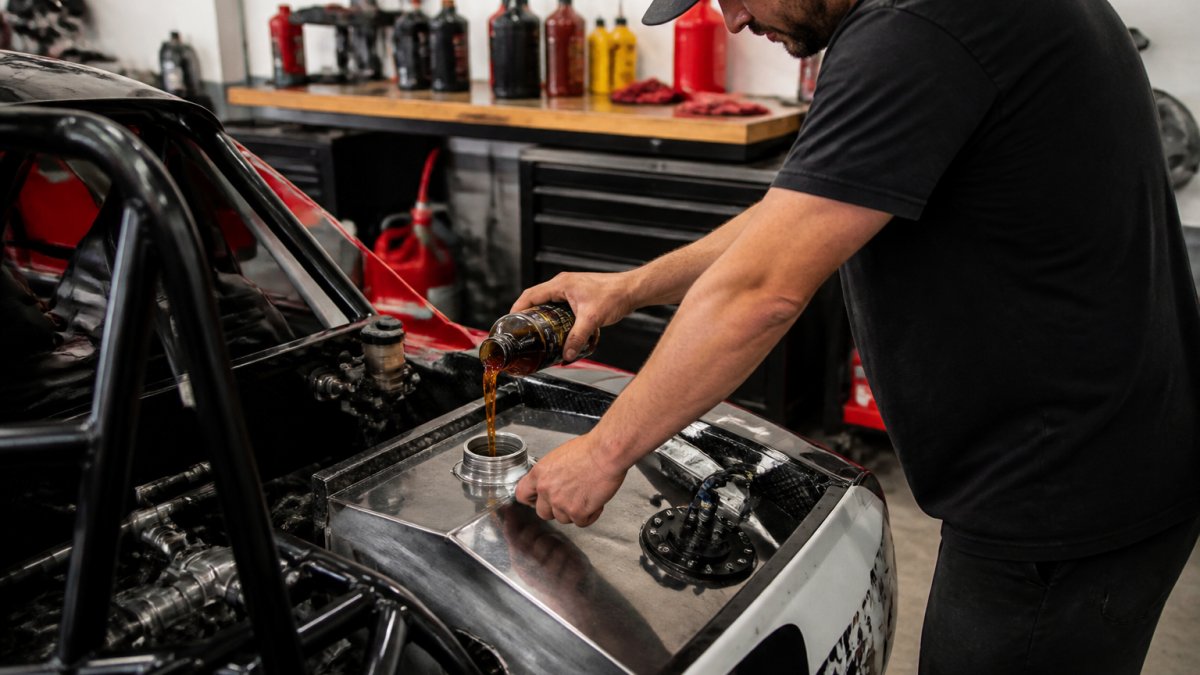
What you're buying is a higher effective octane rating in the tank, margin against knock that lets a turbocharged or supercharged engine stay on boost without the ECU pulling timing.
Octane Points vs Octane Numbers
An octane number is the absolute rating of the fuel, such as 91, 93, or 100. An octane point is a unit of increase: adding "3 points" means moving from 93 to 96, not from 93 to 96 on some separate scale.
Many products advertise "up to 10 points" and bury the fine print: that figure assumes a tiny treatment volume in a small sample, not a full tank. Scale the dose to a real tank and the gain shrinks fast.
Knock, Detonation, and Pre-Ignition Explained
Engine knock is uncontrolled, premature combustion of the air-fuel mixture after the spark plug fires, producing the characteristic ping. Detonation is that pressure spike taken to a damaging extreme. Pre-ignition is worse: the mixture ignites before the spark, often from a hot spot in the chamber.
High-octane fuel and effective boosters raise the threshold at which these events occur. In a race engine on high compression or boost, that threshold is your entire safety margin, lose it and you're looking at melted pistons.
What to Look For in the Best Octane Booster for Racing
Ignore the front of the bottle and read the back: the dosage table and testing notes decide whether a racing octane booster is worth buying. But first know what your engine demands, the best booster for a naturally aspirated 11:1 bracket car is not the best for a 20 psi turbo build.
Start With Your Engine's Octane Requirement, Not the Bottle
Work backward from the build. Four variables set your knock margin:
- Compression ratio. A naturally aspirated 10.5:1 engine on 93 octane may need only a small bump to run full timing; step to 12:1 or 13:1 and required octane climbs sharply.
- Boost. Forced induction multiplies cylinder pressure and heat, and the relationship isn't linear, the last few psi are the most knock-prone.
- Ignition timing and cam profile. An aggressive timing curve or big-overlap cam eats into your margin. If your tuner is already pulling timing to stay safe, you need more octane, not more boost.
Log your current setup, note where knock or timing retard appears, then choose the smallest measured octane increase that removes it. More octane than you need is wasted money; less is a grenaded piston.
Match the Booster Type to the Fuel and the Rules
Boosters are not interchangeable. The main families behave differently in a race context:
- Manganese-based (MMT) boosters deliver strong gains at low treat rates, but leave orange-brown deposits on plugs and chambers and are not street-legal in many jurisdictions.
- Ferrocene (iron-based) boosters raise octane effectively but can leave conductive iron deposits that foul plugs and interfere with sensors. Best for engines you inspect regularly.
- Race-fuel concentrates and true race gas deliver the highest, most consistent octane, at higher cost with sourcing and storage obligations.
Then check the rulebook. Many sanctioning bodies restrict or ban specific additive chemistries, cap octane, or require fuel to pass a spec test. Confirm what your series permits before building a fueling strategy around a product, a booster that wins on the dyno but fails tech is worthless.
Boost Strength and Measured Octane Increase
Look for a stated octane increase tied to a specific base fuel and treatment ratio. Vague claims like "increases octane" tell you nothing; a credible product says "raises 93 octane pump gas by X points at Y ml per gallon."
When comparing products, hold the variables constant: same base fuel, dose, and test method. A claim measured on a small lab sample at a heavy treat rate won't survive scaling to a full 15-gallon cell.
Dosage, Treatment Rate, and Gallons Treated
Treatment rate is where cost and practicality collide. A product needing a full bottle per few gallons is expensive and awkward to mix at the track; one that treats a large volume from a single bottle is easier to live with.
Check gallons treated per bottle, then do the math against your tank or fuel cell size and sessions per day. A booster that looks cheap per bottle can be the most expensive per lap if it treats only a few gallons.
Cost Per Treated Gallon and Real Alternatives
Price per bottle is meaningless alone. Divide bottle cost by gallons treated to get cost per treated gallon, then compare that to buying higher-octane pump fuel, blending race gas, or having your tuner adjust the calibration for the fuel you already run.
For some builds, a booster wins on cost and convenience. For others, especially dedicated race engines needing a large, fixed octane step every session, buying the right fuel outright is cheaper and removes mixing variables.
Octane Booster vs Race Fuel: Which Fits Your Build
The honest answer depends on how much octane you need and how often. Octane booster vs race fuel isn't a contest with one winner; it's matching the tool to the job.
Factor |
Octane Booster |
Race Fuel |
|---|---|---|
Octane gain |
Moderate, additive-dependent |
High, fixed by blend |
Convenience |
Mix at the track from pump gas |
Requires sourcing and storage |
Cost model |
Per treated gallon |
Per gallon purchased |
Best for |
Occasional track days, knock margin |
Dedicated race engines, max octane |
Storage |
Small bottles, long shelf life |
Bulk storage, handling rules |
A weekend track-day car with mild bolt-ons usually does fine on a quality booster over pump gas. A dedicated race engine on big boost or very high compression often needs the real thing.
How to Use Octane Booster Safely at the Track
Safe use comes down to dosage discipline, chemistry awareness, and a few habits that keep your fuel system and engine happy. At the track, the process includes rules, storage, and transport, not just pouring a bottle in the tank.
Dose Correctly and Mix in the Right Order
- Measure the dose against actual fuel volume, not an estimate. A fuel cell marked "15 gallons" rarely holds exactly that.
- Add the booster before pumping fuel. Incoming fuel disperses it far more evenly than pouring onto a full tank, which can leave a concentrated slug.
- Never exceed the maximum treatment rate hoping for more octane. Past the recommended ratio, gains flatten while deposits and plug fouling climb.
Know the Compatibility Risks Before You Pour
Different booster chemistries interact with different parts of the fuel and emissions system:
- Oxygen sensors. Metal-based additives (notably iron and manganese) can coat or contaminate O2 sensors over time, skewing fueling. Wideband tuning sensors are especially worth protecting.
- Catalytic converters. Leaded and certain metal-based formulas can poison catalyst material. Modern unleaded boosters are generally safe at recommended doses, but chemistry decides it, not marketing.
- Spark plugs. MMT and ferrocene products leave colored deposits (orange-brown or rust-red) on plugs and chambers, so inspect plugs more often and weigh whether the gain is worth the maintenance.
If your car still runs a catalytic converter or sensitive sensors, choose an unleaded booster and stick to the recommended dose. If you've removed the converter for track use, the catalyst concern disappears, but plugs and O2 sensors still care what you pour in. Ask for safety documentation before you buy.
Track Rules, Handling, Storage, and Transport
This is the part most guides skip, and where racers get caught out:
- Event fuel regulations. Many series restrict fuel types, cap octane, ban specific additive chemistries, or require a spec test. Confirm what your sanctioning body and track allow before committing to a product.
- Handling. Treat boosters like any concentrated chemical: gloves and eye protection, no open flames, no decanting into unlabeled containers.
- Storage. Keep bottles sealed and out of direct sun. Heat and UV degrade some formulations, and a partially used bottle in a hot trailer is a gamble.
Verify Results, Not Just the Label
After your first sessions on a new additive, check the evidence: read the spark plugs, review logs for knock or timing retard, and confirm fueling is where you expect it. If the booster works, you'll see the knock margin you wanted without new deposits or sensor codes. If not, the product, dose, or base fuel is the problem, and more additive won't fix it.
Does Octane Booster Hurt Catalytic Converters?
Most quality octane boosters are safe with emissions equipment at recommended doses, but the answer depends on chemistry. Does octane booster hurt catalytic converters?
The risk comes from additives that leave metallic deposits. Leaded compounds and certain manganese-based packages are the usual culprits.
If you've removed the converter for track use, the concern disappears, but plugs and oxygen sensors still care what you pour in.
Common Mistakes When Choosing a Racing Octane Booster
Most bad purchases trace back to the same handful of errors. Avoiding them saves money and engines.
- Trusting the headline octane claim without reading the test conditions
- Confusing octane points with octane numbers
- Buying on price per bottle instead of cost per treated gallon
The pattern is always the same: buyers optimize for the number on the bottle instead of results in their own tank. Do the opposite and you'll rarely go wrong.
Conclusion: Picking the Right Octane Booster for Your Race Engine
Choosing well comes down to matching measured octane gain, treatment rate, and cost per treated gallon to what your engine actually needs. Get those three right and the brand matters far less.
That's the standard we hold at The Boost Pros. Our curated lineup includes BOOSTane octane boosters and specialized race fuels, selected for engineering and value rather than a loud label, alongside VPO Liquid Boost oil vitalizers.
Frequently Asked Questions
Do octane boosters actually increase horsepower?
They can, but only when the engine is knock-limited. If your race engine is pulling timing because of detonation on pump octane, adding a booster that raises octane by a real, measured amount lets the ECU or tuner run more aggressive ignition timing, which produces more horsepower. On an engine already running the right fuel, a booster will not add power on its own. Look for products with lab-tested octane increase claims, not just marketing labels.
What is the difference between street and racing octane boosters?
Street octane boosters typically raise octane by a small amount and are blended for daily drivers, catalytic converters, and oxygen sensors. Racing octane boosters are usually more concentrated, may use different chemistries, and are designed for off-road or track use where emissions hardware is often removed. Some racing formulas are not compatible with catalytic converters or street-legal fuel systems, so check the label before using a race-focused product in a road car.
Can octane boosters damage my fuel system or sensors?
Most reputable octane boosters are formulated to be safe with fuel systems when used at the recommended dosage. Problems usually come from overdosing, using a racing-only formula in a car with catalytic converters and oxygen sensors, or buying products that rely on MMT or other metallic additives. Follow the treatment rate on the bottle, avoid repeated overdosing, and choose a booster that states compatibility with your fuel system and emissions hardware.
How many points of octane can a booster realistically add?
Real-world gains vary widely by product and base fuel. Many consumer boosters claim gains in the range of a few octane points, while stronger racing formulas can claim more, but the actual increase depends on the starting pump octane, the treatment rate, and the chemistry. Be skeptical of labels that promise huge gains from a small bottle. Check for lab-tested or measured results rather than relying on the number printed on the front of the bottle.
Picking the right fuel strategy for a high-compression or boosted engine is where builds succeed or fail, and guessing is expensive. The Boost Pros curates octane boosters, race fuels, and VPO Liquid Boost oil vitalizers so you can match a proven product to your setup instead of gambling on a label. Get started with The Boost Pros and give your engine the knock margin it was built to use.